• Skip to primary navigation
  • Skip to main content
  • Skip to footer
Your Own Place

Your Own Place

Norwich

  • Facebook
  • Instagram
  • LinkedIn
  • YouTube
Coming on a workshop
Commission Us Now
  • About Us
  • Our Services
  • Our Impact
  • Blogs and News
  • Contact Us

Blog

Resident engagement – in friendship terms

businessequip · 15/09/2021 ·

Resident engagement – in friendship terms

Engagement. It’s a word our sector uses a lot and we all do it a lot. There is undoubtedly some very good practise in the housing sector and some really poor practise too. And then there’s those that pretend they’ve got good practise nailed and those that wonder why it doesn’t work. 

Here’s the thing. When we make a new friend, get chatting to someone in the gym or go on a first date, we don’t consider our approach to engagement. We’re just the best version of ourselves when we’re with others (mostly). 

What does engagement even mean? It surely means building a positive relationship akin to our values. In our sector, essentially, this means we aim to get people to do things we want them to do. How different is that in a personal relationship in as far as we want that person to be in our ‘tribe’. Engagement means not being a d^*%, treating people decently, being honest (which may mean vulnerable), being reciprocal, apologising from time to time, making some kind of commitment and showing up – to quote the great Brené Brown. 

With the Housing White Paper comes a renewed focus on resident engagement. This has to be a massive opportunity for us all, including those kidding ourselves that they’ve got this nailed, to explore what engagement means in practise. 

So here’s what all those normal human approaches to a friendship might practically look like in the housing sector and repackaged as engagement. 

  • treating people decently – this means telling the truth if you have to change plans or got something wrong. It means listening to their suggestions (and again – being honest about why you might ignore some)
  • being honest and brave (which may mean vulnerable) – as above, there are very few reasons that people can’t be trusted with the truth if you just have to change the date. Or if you have not met the plans for year one – discuss and share why. This will give huge insight into your world and build empathy. 
  • being reciprocal – we’re humans and generally pretty selfish. If someone does something for you, do something back. But don’t assume it’s a voucher they want (would you get that for your friend after they gave you a lift to the garage?). Ask (explaining the parameters you have) what people want and keep asking. People change. 
  • apologising from time to time – wow it goes a long way. And with no ‘buts’. Just say sorry – I stuffed up and I’m human. 
  • making some kind of commitment – good engagement takes time, values, energy and money. You wouldn’t start a relationship saying that you’ll probably have to end it in a year as you’ll run out of capacity. Be honest about the challenges, involve people in the solutions and own your commitment to finding a way forward. If it’s really just for a year – be honest about that, set realistic aims and consider how this will impact on your relationship. 
  • showing up – be your best! This is the one that might differ from a friend. A good friend will let you have a bad day. Resident engagement is a job – people rely on and trust you. Don’t sit on your phone or look bored. For that time to be worthy of their time and commitment, follow all the steps above to being your absolute best. People deserve no less.
Why tenancy sustainment work is more important than ever

businessequip · 05/08/2021 ·

Why tenancy sustainment work is more important than ever

Tenancy sustainment work has long been important for landlords not only wishing to ensure the rent is collected, but to support their tenants to thrive in their homes. In this piece Rebecca White explores why it matters now more than ever and shares her organisation’s empowering approach to achieving it. 

We’re all emerging into a world that has changed forever.  If there is a new normal, for many it is one that means more competition for jobs that don’t pay, worsening mental health and fewer opportunities.  The financial headaches for us as individuals must surely be replicated corporately in the boardrooms of housing associations up and down the land. 

Of all the partners we work with, we’ve huge empathy for our colleagues in social housing.  Not a conversation passes when we don’t learn of concern for a particular tenant, the extraordinary lengths many have gone to to keep people safe in their homes, maintenance teams now grappling to catch up with repairs and tenants disengaging due to anxiety and months of isolation. All the while the business model depends on the rent being collected every single week.  

So why is it then, when engagement for the purposes of tenancy sustainment is so important, that the actual people engagement is often so poor? As organisations that spend a lot of time and money trying to engage, why is practice so mired in assumptions, people feeling patronised and being mis-advised rather than listened to? Why are tenants blamed when systems don’t work and judged when we can’t know their lived experience or what choices look and feel like to them?

Against this backdrop of missed opportunities how does a system that has been managing crises for a year, return to a ‘prevention’ mindset and rebuild the relationships necessary for tenancy sustainment? 

Because it has to. To ignore the prevention agenda now would likely prove dangerous financially.  It would also be harmful to the very people landlords regard as valued customers and whose lives are wrapped up in the place that should be their safe and secure home. One housing association confided in me that even before Covid19, over 85% of their tenants had less than £10 in savings. Since Covid19 the number of people claiming unemployment benefits has risen 120% and Shelter reports that over 80% of social housing tenants have no savings at all. In terms of the safety net, there isn’t one. Whilst many of us are cautiously optimistic about the vaccination programme, the ending of the furlough scheme looms for more than five million people in October. It poses new risks to those in insecure and uncertain jobs. The economic tail of Covid19 will wag for years and probably decades with many housing associations already reporting increases in rent arrears. 

At Your Own Place we work to sustain tenancies and prevent homelessness. With a starting point of equality, we create workshops for people who are as diverse, worthy, talented, frustrated and experienced as any of us.  Who hasn’t sat in dull training because it doesn’t suit our learning style?  The need to adapt, keep it engaging, manage diverse styles and overcome barriers is just as present in our tenancy sustainment work. 

Nowhere is it more tested than in our group delivery. In groups of just eight (and six online) we deliver Tenancy & Independent Living Skills Plus (TILS+ or DigiTILS+). We extend our value of equality into taking an asset-based approach.  We leave assumptions at the door.  There is no cynicism and we are relentlessly upbeat (whilst acknowledging and empathising when life is unfair). We deliver group work that builds on what people do know and can do rather than when things have gone wrong or they have picked up a label not of their choosing. 

Notwithstanding the importance of managing risk, as an independent organisation our strength is starting with a level playing field. There’s no backstory, no history of rent arrears or the big dog.  These are the kinds of things that it’s all too easy to get hung up on, blame people for and use as an excuse to label tenants ‘hard to reach’.

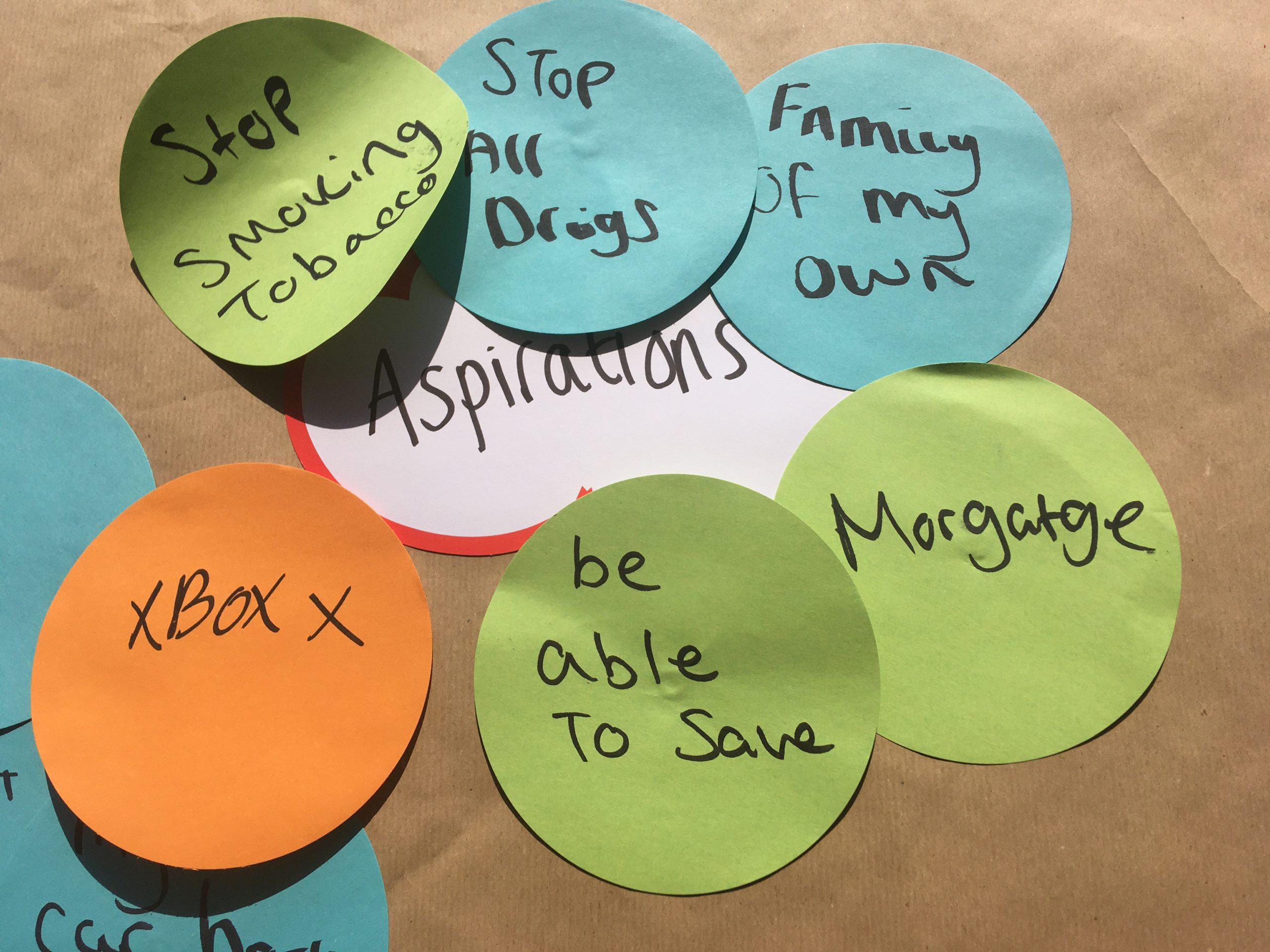
Our approach is to work in small groups. Mostly our facilitation doesn’t even need tables, as there’s almost no writing. In a group of tenants ages 20-60 and when your starting position is equality, the chances are they’ve collectively got the answers. We ‘simply’ facilitate the emergence and recognition of their own skills, knowledge and solutions. So whilst we measure the outcomes related to knowledge around financial skills as crucial to achieving our outcomes, the ones that matter are the ones that relate to their own confidence and faith in their own ability to solve the next problem.  

In our groups the age range may equate to 100 years of shared tenancy experience. 100 years! It would be criminal for everyone else in the room not to benefit from this. What’s more it would be sheer arrogance for us to pretend we know more. Our framework of modules and thematic areas (money, housing and relationships) to work through guides the room to their own eureka moments. One person may benefit from another’s previous eviction experience or a tenant’s knowledge of a nearby debt agency that helped their mum out. This is peer learning at its absolute best. 

Over 87% of our trainees report increased tenancy skills and 82% improved understanding of their bills. Perhaps most importantly we have 94% retention on our workshops – building the relationships and human contact that has been lost over the last year. The case for group work is strong.  Stronger against a backdrop of a Housing White Paper advocating for an empowering approach to working with tenants. The case for values and independently-led tenancy sustainment group work is the strongest it’s ever been.  

To find out more contact rebecca@yourownplace.org.uk mob 07530 028446

Reflections on working in a new area

businessequip · 13/07/2021 ·

Reflections on working in a new area

How did you feel when you read about the cultural revelations at Brewdog?  And if you’re a founder or leader, how did you feel? With plans to scale these stories hit hard. In recent times though, and not because of Covid19 (or Brewdog), I’ve come to the view that small(ish) is beautiful (the horizon is already receding you’ll be pleased to know).  Probably because of a need to prove myself, I thought that success meant Your Own Place had to be huge.  Latterly I’ve been of the view that it doesn’t and shouldn’t be. It’s not about getting beer into the mouths of millions, it’s about making a phenomenal difference in the right way. 

As we venture into a wider geographical area with a narrower focus on the business offer, scarcely a week goes by when a tale of business woe like that of Brewdog doesn’t make me draw breath.  Last month we heard of their cult of personality and what getting it really wrong looks like (and more importantly, feels like).  If that doesn’t make you look in the mirror, nothing will.

So it is with relief that we focus on being the right size for the impact we want to make.  Nothing about that decision makes any of my efforts to scale well any different.  If anything, staying modest in size means there’s nowhere to hide and retaining our quality matters more than ever.

I wanted to share my five-point scaling plan (mostly because I wish someone had shared theirs with me)

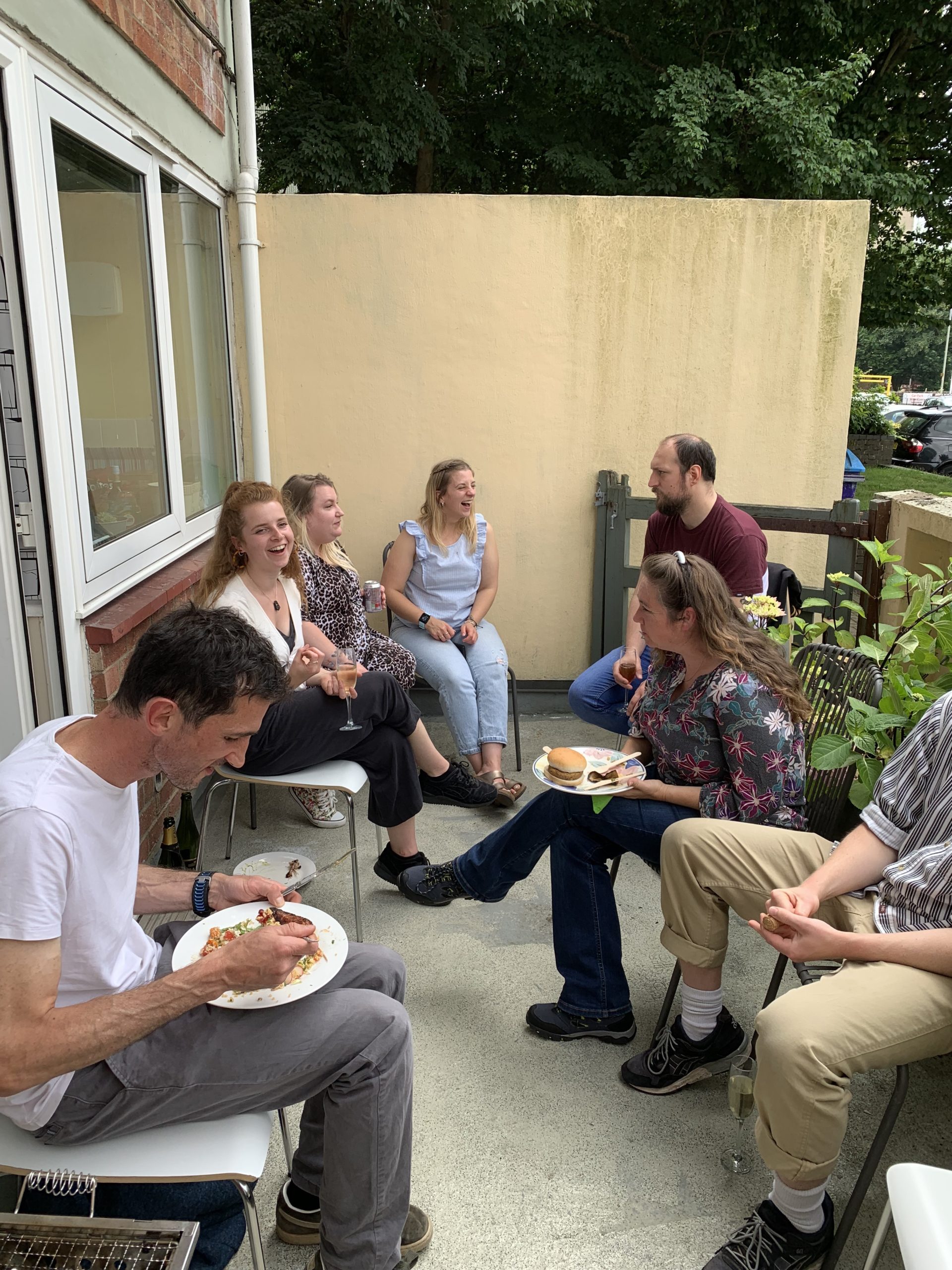
1. People – of course it starts (and ends) with us.   If the people we support matter then those supporting them have to matter too. We’re not cool (or rich) enough to have a Director of People, but what we do have is oodles of empathy, compassion, passion and strategic thoughtfulness in our team and in the face of our first ever Operational Manager (Jess Luce-Rackham).  She sets an amazing precedent for our our first rung of management. Thanks to her (and team as test-bed), all the little (and big) things I have endeavoured to do, are being questioned, embedded, improved and codified (you’ll read that word a lot).  From ensuring birthdays are remembered, to time for us (team-time and BBQs) to really developing people because they matter (not just for the business) to giving people the best induction I never add and values-proofing literally every document and decision we make. Our people, even when they p*** me off, will always be looked after.  The mantra for how to treat people and how I check myself when I’m starting to feel snarky comes from Michelle Obama – ‘when they go low, we go high’.  Our aim then?  To attract and nurture the best who want to stay only for as long as they are happy! 

2. Belief in and communication of the model – it’s taken a while, but I trust it – implicitly.  It’s natural (and healthy) for any of us to get nervous before our facilitation.  It’s complex to deliver, we’re often meeting strangers for the first time in a new environment and with unexpected elements due to the barriers our trainees face. What’s vital to remember is that it’s almost never about us.  It’s about the model.  It works.  It’s tested, keeps working and it’s always worked.  No matter what or with whom you’re facilitating, with the right preparation and our values, it gets trainees to where you want them t be.  As we work in new areas, it’s incredibly satisfying to turn up somewhere new, not knowing much and guess what?  It works! This means we have to codify and replicate every core aspect. 

3. The back office – yes, it really matters.  From our database, our annual leave portal, our email server, our systems for co-working, processes for managing impact, schedules for reviewing our progress, payroll and every last one of the 44 policies, they all have to work whether we have two people in the team or 200 people in the team.  Conscious that start-ups grow, iterate and evolve in their founder’s image, it is important now to stress-test the systems and make sure they are effective as we grow and remain cost-effective.  Most important is the voice of the team.  Through creating a culture of being heard, creativity being encouraged and ideas being acted upon, the team knows best what they need and are crucial in this workstream.

4. Delivery – delivery is the other part of the codification.  In order to make a difference, be the best quality and be able to quantify the difference we make, there is a lot more to facilitation than facilitation.  Whether it’s engaging new customers, designing new content, engaging trainees, developing resources, devising outcomes frameworks or iterating all the cloud-based systems that sit behind them – this all has to be codified to be replicated. Lose the precision and we lose the impact.  In addition, if we’re facilitating in a new area, this means we need to research and understand it too. We may not need to be experts (in our asset-based model that sit with our trainees!), but we need to listen and understand their context in order to be able to respond.  As we move into more areas we will codify the questions and approaches we need to take.

5. Finance – I thought I might get in trouble if I left this off!  Honestly, I’ve loved becoming a finance person, developing the confidence to have finance conversations, do my own VAT returns and report on profit and loss.  The reality of staying small is figuring out what size we have to be to be sustainable, make a profit to make a difference and repay our social investors.  This was never about getting rich.  Your Own Place was founded on no cash from me or anyone else. It was built up on the side of a full-time job at the council and then upon finding myself suddenly single and leaving the council, hard graft to literally pay my bills on my own.  For the endless cold callers that see ‘CEO’ and email me with their offers, unless it’ll make a difference to the team and our people, we probably won’t buy it. Of course that doesn’t mean we don’t have to invest in the back office to free up capacity for the team (including me) to be more effective. As Your Own Place ploughs all its profit back into the mission it’s not my plan to have any money, any time soon. I’ll continue to assume no-one minds me turning up to meetings on my bicycle and feel incredibly lucky to have been nurtured with those values. It means I respect the finances, but am neither obsessed nor impressed by them.  

They are a means to a purposeful end and that end is number one again – people. 

Have a great summer!

What people don’t dare say about working with people with ‘lived experience’

businessequip · 09/06/2021 ·

What people don’t dare say about working with people with ‘lived experience’

You’ll be unsurprised to learn that Your Own Place hasn’t always gone to plan. As far as there has ever been a plan, a good deal has been jettisoned and I’ve not always even admitted it or had time to reflect. 

Thanks to the extraordinary (and mostly hugely positive) experience of leading a team in London where almost everyone had ‘lived experience’, this was the early ambition at Your Own Place. On arrival in Norfolk eleven years ago this was not common – or maybe people just weren’t talking about then. They are now and rightly so. 

Whether you call it ‘participation’, (my favourite), user-voice (yuck!), client engagement (double yuck) or any other euphemism, listening, including, inviting and responding appropriately to those with mixed and lived experience, as equals, is fundamental. Lived experience is a euphemism too, of course, and covers a vast spectrum rather than a binary ‘them’ and ‘us’. Be in no doubt that many of us have trauma and support needs that remain unaddressed and unhealthily play out in the workplace.  

What participation of those with lived experience of homelessness can’t and shouldn’t be is the only voice – any more than than those without lived experience or any other exclusive experience. 

Faced with the dilemma of wanting real participation and inclusion in the business and some pretty tough moments from south London still resonating hard, it was with this ambition that I started Your Own Place. in 2013 it wasn’t about including people in strategy, finance, the Board and marketing, rather in direct delivery. The very first funded course at Your Own Place saw five young people trained (brilliantly by The Participation People) to be TILS+ trainers. This was to be a fabulous virtuous circle of people gaining job skills whilst being the most authentic and credible in delivering our workshops. 

Sadly, the lessons of London remained pertinent in their readiness to work (and the business’s readiness to give them work too!). Making the judgement about when people are ready to work with you versus just how much resource your HR department (me!) has to support people facing many of life’s challenges, remains as much of an enigma now as it was then. Still committed to employing and involving people from all backgrounds, we also have to be honest that some people (as with any member of any team) simply won’t make it in our particular line of business. 

The sector, our customers and commissioners need to start being honest about this or we set people up and let people down. We are not in the business of, and neither do we have the resource to, ‘fix’ people. How then do we decide who is ready, well enough and happy to join our team? If they self determine this, is that enough? Can people ever know enough about a role and full-time work to know they are ready for it? These questions are no different to any of the mysteries of HR and recruitment. It’s a very imperfect science with potentially damaging consequences. 

When you’re ‘keyman/woman dependent, as a small business is, these are huge decisions. The risk isn’t only to the business, but another potential ‘failure’ for the individual involved as well as ending up with a bunch of colleagues who look and sound like me! No thanks – there’s way too much of that already! 

Working in this way remains the ambition. However, at the moment it is mostly a stretch too far. Having said that, we have some superb peer volunteer mentors acting as people who have walked in tough shoes. As a route into employment, this is a brilliant one. Mostly though, people deserve better than employers doing it badly. We all deserve the right help and support to get to where we need to be – to be well and happy. It therefore requires the right resource, universal and Board commitment and skill. 

Instead, our Your Own Place Advisory Board (YOPAB) contributes in other impactful and important ways, gain the benefits of doing so and we’re resourced, for now, to making it work. Thanks to Covid19 delays, we are seeking ongoing temporary funding with a view, long term, to investing our profit in doing it our way and better. Whether commissioners will pay for this, that they apparently hold in such high regard, remains a moot point. 

So my top tips for meaningful participation after all this time (still) are:

  • Value your people by rewarding them
  • Make it a win-win – the organisation gains as much as the individuals
  • Be patient – members come and go
  • Make it inclusive for people to get involved in a way that suits them
  • Have a variety of projects people can get involved in so that there is something for everyone
  • Reflect in 1-2-1s between meetings and learn from member’s feedback
  • Have progression and exit routes – paid work, if desired, should be the next available step
  • Believe they can do anything – our aspirations should never be the limitation

Good things come to those who wait

businessequip · 27/05/2021 ·

Good things come to those who wait

In the midst of a complicated schools project, recruiting 100 new volunteers and multiple commissions in new areas with new customers, 2021 hit us at full speed.  When Jess, our Operational Manager, kept speaking of things we’d get done in ‘quieter times’ I didn’t have the heart to say that there probably wouldn’t be any.

As a start-up there are no rules – just vast uncertainty, ranges of emotions and assumptions that if you’d only done something different then wouldn’t things be better. Self-doubt is part and parcel. I honestly don’t think ceasing and furloughing crossed my mind last year and quick decisions were undoubtedly made. That they appear in hindsight to have been the right ones doesn’t necessarily mean they were – rather our skill for making the best of the situation we find ourselves in. I’ve always thought this a brilliant self-preservation characteristic. 

Your Own Place is in its eighth year. As a Community Interest Company that is still here after eight years,  survived Covid19 and is in fact growing its paid team with increased traded income, makes it something of an outlier. 

Many businesses have talked about years worth of transformation during Covid. We are no different. Faced with temporary closure, a return to a charitable model and ploughing on to do the work we do, there was simply no choice. Being mission driven to deliver complicated and sophisticated interventions meant that it would have been hard to simply start selling something else. This combined with the very early warning signs that the need for our service and the difference we make was only likely to go in one direction. That need equates to demand is not an assumption we make – it is my job to ensure our offer meets the evolving need sufficiently to receive the elusive investment required. 

2020 was always going to be a pivotal year for Your Own Place, with social investment resulting in our first Operational Manager. I for one am thankful for the light that the horrors of the last year have shone on the need for our service. Pairing back, distilling the core parts of our service, taking it online and starting new conversations have all led to our current growth and new contracts. 

Our need to grow, to recover, to deliver quality has meant a relentless focus for 2021. Finally, I know what it is we do best, what it is that is needed, what difference we make, what we need, what is commercially viable and how to talk about it. These moments are years (and pandemics) in the making. Sometimes conversations go on for years before a penny drops, demand is unlocked and trust created. We have no right to exist and no charitable donations that we get regardless of whether we’re any good. 

So when people say to price yourself properly because you’re a life-time in the making, it is the same with a social business and the contracts we’re starting with new customers. One such contract we’re thrilled to have got off the ground is with Saffron Housing. During the pandemic, their charitable foundation very kindly donated money to Your Own Place and they’ve been lovely, supportive and encouraging ever since.  I recall being genuinely touched as I’d had little contact with Saffron and didn’t know we were on their radar. And so the conversations, alignment of values and need for our service emerged too. We can’t wait to train their tenants, learn from their experiences and provide the catalyst for people who just want to call a house their safe and secure home. 

  • « Go to Previous Page
  • Page 1
  • Interim pages omitted …
  • Page 10
  • Page 11
  • Page 12
  • Page 13
  • Page 14
  • Go to Next Page »

Footer

©Your Own Place CIC | Built by Business Equip

Log in
  • Privacy Policy
  • Equal Opportunities Policy
  • Equal Pay Policy
  • Equal Recruitment Policy

©Your Own Place CIC. We are registered in England and Wales. Company number 08751344.


Copyright © 2026 · Your Own Place on Genesis Framework · WordPress · Log in